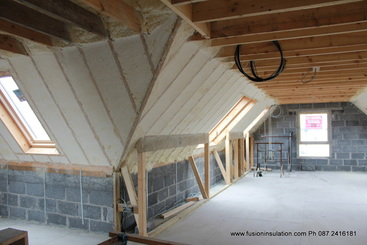
Attic Pics

artsexylightbox

Uber House

artsexylightbox

FUSION'S UNIVERSAL "INSULATION LAW"

"FUSION'S FIRST LAW OF INSULATION"

"If you use the insulation you have always used you will get the results you have always got"

What are those "results" we refer to:

  • Outrageous heating bills
  • Dampness
  • Draughty Rooms and Hallways
  • Uncomfortable Home and Work environment
  • Cough's, Sneezes, and Aches and Pains

Here at Fusion Insulation we are zealot like in our mission to spread the 'insulation' good word. If its any consolation we have lived in homes that were badly insulated or had ineffective insulation. We have also spent way too much on heating bills and we have suffered through draughty and damp accommodation. Then we found the way. It came to us like a revelation. It was SPRAY IN PLACE FOAM INSULATION. The highest performing seamless insulation on the market today. No other insulation can insulate your home and office like  

FUSION SPRAY IN PLACE FOAM INSULATION

can.
________________

The Ordinary Guy's Guide to "U" Values


Discover why "U" Values are only half the story for Truly Great Insulation
.

If your insulation has a great U value on paper but in practice it doesn't seem to be doing its job , then you're about to discover that U values are only half the picture and why you need the double act of U values and Airtghtedness in your home, office or building for that truly "Bali" Beachouse feeling of warmth and dryness

Let's get the basics covered first; U values are a handy way to simplify what can be a fairly black art. "U" values are a measure of thermal resistance. In other words, a U value rating will give you some idea as to how 'difficult'  that insulation will  make it for heat or indeed cold passing through it, for a given depth of that insulation. To avoid freezing, in the winter you want to keep the heat in and in a baking summer you dont want your home or office becoming like an oven. The better the U value per inch or mm depth of insulation (the lower the figure) the better your home, office or building will retain its temperature. In the USA they use an R value system which is kinda like the reverse of U values, so the higher the R value the better the insulating abilities.

Simple so far? Well here's where the plot thickens. You see a U value is not a real world figure. Its measured in a laboratory and lots of people with pointy heads and lots of letters after their names, write whats know as  'protocols' or proceedural reports as to how they achieved these test results. Now you would be surprised to discover that a lot of insulation types achieved great U values from these laboratory tests, under strict laboratory conditions i.e. pretty much as near non real world conditions as you could imagine. We're not suggesting that these scientists have deliberately done a bad job. Hey, it must be very difficult in fact design just one test thats able to provide a 'universal' value system applicable to dozens and dozens of different types of insulations , but its you the end user that shells out for insulation that you thought would do the job, only to find out afterwards that in the real world, that insulation is not performing.

Let us give you an example. Its blowing a force 5 outside your home and the humidity in the air is 85%, and you have cavity walls and a standard, typical ventilated attic space . Would you want an insulation in your attic that couldnt handle air movement across it, or lost most of its of its U values if it got damp?  Would you want an insulation that sagged when it got damp and compressed down so it became ineffective as an insulation? Well the shocking news is that there are many insulation types out there that achieved excellent U values from lab tests, but cant repeat those results in the real world, of your attic, walls or floors.

What's needed is an insulation that tough, rugged, wont sag , compress, and yet retain its thermal resiistance properties over time. You need and insulation that forms an airthight seal , in situ, in your attic walls and flloors. You want an insulation that will shrug of water, rain, and moisture and will literally cold shoulder force 10 gales into touch. You want all this and a reassuring lifetime warranty. You want Fusion Spray In Place Insulation Foam becasue you never want to second guess the most important element of your enjoyment and satisfaction in your home, office or building.

"Comparing Apples with Apples"

But wait there's one more potential 'pothole' when it comes to comparing U values. There are some insulation brochures out there, that while not being misleading are perhaps a little economical with the facts e.g. Some brochures and literature quote a U value for say a 100mm insulation panel and it looks great.


You're about to place an order but then you read the small print at the bottom of the page (and we're talking 7 font small print here), and you notice that the U values quoted are in fact "typical as built U values" In other words they have calculated the plasterboard, the plaster, the insulation, the typical two course cavity block construction and the typical 20mm of external render that would be on that wall.

Hey why not include that cat sitting on the window cill as well?

So in practice their insulation seems to be performing spectacularly well , but not so well when you subtract the other materials they have thrown in. So the moral of the story is ,

"STUDY THE SMALL PRINT CAREFULLY"

Always compare like with like, Apples with Apples and Oranges with Oranges

Below are our REAL WORLD "U" values and these "U" values will be there in gales force winds, raginging storms or heatwaves. Our insulation is backed by a Lifetime Warranty after all

_________________

ATTIC INSULATION - WHAT YOU WILL DISCOVER IN THIS INDUSTRY LEADING VIDEO IS THE WAY TO HAVE THE AIRTIGHT ATTIC INSULATION YOU HAVE ALWAYS DREAMED OF YET NEVER HAVE TO WORRY ABOUT WET ROT OR DRY ROT!
("Its all to do with installing a proper vent system first")

If you're serious about ATTIC INSULATION or you just want a simple straight forward answer to the age old question "what's the best attic insulation", DON'T MAKE ANOTHER DECISION you’ve read what’s in this explosive report from FUSION INSULATION.

CLICK ON THE PHOTOALBUM BELOW TO VIEW FULLSIZE


Discover how and why most attic insulations under perform in real world conditions outside of the laboratory and why, if you insist on putting the same attic insulation as millions of homeowners across this country already have, then you probably will get what they have always got i.e. a cold, draughty, hard to heat homes and buildings.

Hey, we agree with you, the attic is the most neglected room in your house. Why is that ?. Its not just because its hard to get into and because you have filled it with junk . Let’s face it, the reason you dread going into the attic is because it’s usually freezing cold and draughty.

Have you ever asked yourself why you attic is that way? It’s no accident. Your attic, if it’s anything like the millions of other attics around this county has been designed to be draughty and cold.

NEWS FLASH: THE TYPICAL ATTIC HAS BEEN DESIGNED TO BE COLD AND DRAUGHTY... YOU NEED OUR ATTIC INSULATION!


We’re not kidding you. Attics in most houses are designed to be pretty much open to the outside world when it comes to air and draughts. The reason? Well here at Fusion Insulation we have tried to get to the bottom of this craziness. The nearest we can figure is that it’s all to do with letting your timber roof joists and rafters ‘breathe’. Seemingly about two or three hundred years ago, timber used to be cut fresh from the forest and roofs and walls were made from sap filled hewn logs. Now because the moisture was high in these beams of fresh timber, if it wasn’t let dry out properly the wood could rot. Fast forward on a couple of hundred years, and the fresh timber from the forest is now all kiln dried to less than 20% moisture content, structurally tested and has pretty much zero risk of rotting. Yet the regulations still remain. Attics, ceiling cavities and wall cavities are still regulated as requiring ventilation suitable for like 200 years ago. Crazy or what in an age when we need draught free homes and offices?

So if you are wondering why your attic is like Vladivostok on a winters day and the Sahara on a summers day, blame the regulations. It wouldn’t be so bad if what happened in your attic didn’t affect the rest of your house.

I know you’re thinking “hey I have attic Insulation, so I’m protected from all those draughts. Right?”

Wrong!


You see traditionally we bunged roll type insulations up into our attics and while these insulations have great U values on paper, many of these roll type insulations slip up badly in the real world conditions of your attic.  In the real world many of these roll type insulations  simply can't cope with breezes and draughts blowing around your attic. Damp air can blow through sheets of roll insulation with ease. Don't take our word for this . Here’s a simple test you can carry out . Take out your hairdryer and point it at a handful of roll insulation that's in your attic and see what happens.

Almost immediately the air and heat from you hairdryer will get through your roll insulation.

Thats not the worst part . You see the biggest challenge any insulation faces is air tightness. Any insulation is only as good as its joints. Too many joints or badly fitted insulation and heat can escape easily through it.


In recent scientific tests U values were found to have dropped by over 30% when joints were inserted in sheets of insulation.


This has huge implications for your attic, your home and the quality of the environment in your home . Here’s another  simple test you can try. Look around your attic. Is the insulation that’s in your attic tightly fitted between the joists? Does it fit into every nook and cranny ? If you house is more than a few years old we reckon that the insulation in your attic is probably already 30-40% down on its original theoretical performance.

So how do you insulate your attic properly and simultaneously make your attic or loft cavity airtight and draught free? The answer is spray in place FUSION FOAM.

This is no ordinary foam that you can buy in your local hardware store.

Fusion Foam is a two component blend which is mixed under very pressure and extremely high temperature. The mixed formula is then sprayed through a specially designed spray gun . Once directed into your attic cavities the foam cools, and expands hundreds of times its original volume. The effect is literally miraculous. The foam solidifies in seconds and is made up of millions of tiny air-spaces frozen in the now rigid foam. The foam bridges and blocks every opening, every nook and every cranny in your attic and forms a seamless, joint-less barrier to the cold and draughts . What’s more the foam stays in place for life. It wont move, shift, slip down, warp, shrink or tear away from your walls, timbers or joists, guaranteed.

“Guaranteed for how long?” you ask, how about for life! Yes that’s no misprint .

Fusion Attic Insulation carries a building lifetime performance warranty.

Fusion attic Insulation will be performing as well in 10 years, 30 years 100 years (if you building lasts that long) as it does on the day its installed .

Fusion Spray in Place Foam attic insulation outperforms every other insulation on the market today in terms of U values and air tightness. Pound for Pound there simply is no better investment you can make to make your home warmer more comfortable and draught free.


CONTACT US NOW TO RECIEVE OUR BEST PRICE!

Call us:

For Quote -

Lo-Call: 1890 818 838

or

For Technical Queries -

Mobile: 0872416181


Want us to Ring You?

Click here to request a callback


Questions?

Click here and fill out our contact form


OR


email us:

This e-mail address is being protected from spambots. You need JavaScript enabled to view it