Cavity Wall insulation the sprayfoam way
UNLOCK THE SUPER INSULATING POTENTIAL OF YOUR CAVITY WALLS TODAY USING A REVOLUTIONARY LIQUID CAVITY INSULATION THAT ACTUALLY THINKS ITS SOLID
Damp breezes blowing against internal cavity walls are fantastic at chilling your home.
The reason for this is that the internal bocks in your house are great ‘CONDUCTORS’ of heat. They are solid, they are dense and as such can transmit heat from inside your rooms outside, to that breeze that’s in the cavity. The greater the temperature differential the greater the speed at which heat will leave through your walls.
But "Hold on a minute" I hear you say . "What about the insulation in my cavity. Isn’t that meant to stop heat leaving my home and office?"
Well here’s the next big discovery you are about to make;
If your home was built in the 70’s or later chances are that it has some form of cavity insulation. Most cavity insulation installed since the 70’s is what known as foam board or Styrofoam or air-board insulation panels. Usually white, and very light. Now on paper they have great insulation values but when placed in your cavity by block layers or bricklayers they have a huge weakness. That weakness is joints and gaps . Using traditional building techniques these boards are badly butted together in the cavity and are almost never taped along the joints and block ties. Hence the cold air circulating in the cavity of your home or building can get in behind the insulation and pretty much suck the heat out of your home at will.
The shocking truth is that most board insulations installed into cavities are seriously underperforming. We know this sounds harsh but we've lived in enough cold damp houses, and saw enough of them being built, over the years to know what we are talking about.
It's a real challenge to solve the problem of a cavity without any insulation or a cavity with badly fitted or draughty insulation.Traditionally the only way was to drill holes in the exterior skin of block-work through to the cavity and blow material into the cavity and hey presto you filled the cavity, that couldn't really stop that damp breeze we were telling you about earlier.
You see if an insulation can't create an air tight seal in a void or cavity that's ventilated then it's U values will be destroyed by that damp breeze that continually blowing through there. The shocking thing is that most of these bead and fibre insulations are fine when absolutely dry. Get them wet or damp and they no longer act as insulators. Instead they turn into great conductors of heat.
Now heres the really interesting development. Fusion Insulation has a very effective cavity wall insulation that manages to do some really spectacularly clever things all at once.
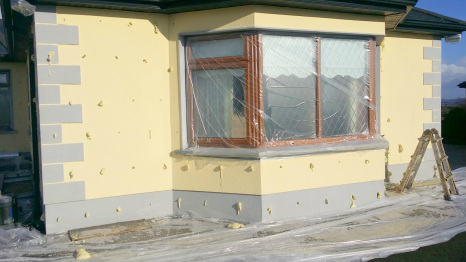
Fusion Slow Pour Foam is just that. What we do is drill holes, like I described earlier, into your outside wall at 40cm centers typically . When we reach the cavity we use our special pumping equipment and in a controlled fashion we inject foam liquid into the cavity. Thats right a 'goopy' liquid into your cavity. It flows down to the bottom of your cavity and after a few minutes sitting there it does something really magical. It starts to set. But it sets in a really great way . You see it expands while it sets. Very Slowly. It rises and rises and fills your entire cavity solid with a low density super ins ulating foam.
Your Cavity is now filled with SUPERINSULATING foam which wont soak water and wont bridge water or dampness across the cavity.
But here's the next great thing.
What your never thought possible can be achieved. Fusion Cold Pour Foam wont shrink, collapse or melt away in the cavity. In fact it comes with a lifetime performance warranty.You get the double benefits of great U values in your cavity and super air-tightness.
So CALL TODAY for a free Quotation!Call us:For Quote -
01 657 1858
Mobile: 0872416181
LAST CHANCE TO WATCH THIS VIDEO WHICH HAS AMAZED THE INSULATION INDUSTRY
Want us to Ring You? Click here to request a callback
Damp breezes blowing against internal cavity walls are fantastic at chilling your home.
The reason for this is that the internal bocks in your house are great ‘CONDUCTORS’ of heat. They are solid, they are dense and as such can transmit heat from inside your rooms outside, to that breeze that’s in the cavity. The greater the temperature differential the greater the speed at which heat will leave through your walls.
But "Hold on a minute" I hear you say . "What about the insulation in my cavity. Isn’t that meant to stop heat leaving my home and office?"
Well here’s the next big discovery you are about to make;
If your home was built in the 70’s or later chances are that it has some form of cavity insulation. Most cavity insulation installed since the 70’s is what known as foam board or Styrofoam or air-board insulation panels. Usually white, and very light. Now on paper they have great insulation values but when placed in your cavity by block layers or bricklayers they have a huge weakness. That weakness is joints and gaps . Using traditional building techniques these boards are badly butted together in the cavity and are almost never taped along the joints and block ties. Hence the cold air circulating in the cavity of your home or building can get in behind the insulation and pretty much suck the heat out of your home at will.
The shocking truth is that most board insulations installed into cavities are seriously underperforming. We know this sounds harsh but we've lived in enough cold damp houses, and saw enough of them being built, over the years to know what we are talking about.
It's a real challenge to solve the problem of a cavity without any insulation or a cavity with badly fitted or draughty insulation.Traditionally the only way was to drill holes in the exterior skin of block-work through to the cavity and blow material into the cavity and hey presto you filled the cavity, that couldn't really stop that damp breeze we were telling you about earlier.
You see if an insulation can't create an air tight seal in a void or cavity that's ventilated then it's U values will be destroyed by that damp breeze that continually blowing through there. The shocking thing is that most of these bead and fibre insulations are fine when absolutely dry. Get them wet or damp and they no longer act as insulators. Instead they turn into great conductors of heat.
Now heres the really interesting development. Fusion Insulation has a very effective cavity wall insulation that manages to do some really spectacularly clever things all at once.
Fusion Slow Pour Foam is just that. What we do is drill holes, like I described earlier, into your outside wall at 40cm centers typically . When we reach the cavity we use our special pumping equipment and in a controlled fashion we inject foam liquid into the cavity. Thats right a 'goopy' liquid into your cavity. It flows down to the bottom of your cavity and after a few minutes sitting there it does something really magical. It starts to set. But it sets in a really great way . You see it expands while it sets. Very Slowly. It rises and rises and fills your entire cavity solid with a low density super ins ulating foam.
Your Cavity is now filled with SUPERINSULATING foam which wont soak water and wont bridge water or dampness across the cavity.
But here's the next great thing.
What your never thought possible can be achieved. Fusion Cold Pour Foam wont shrink, collapse or melt away in the cavity. In fact it comes with a lifetime performance warranty.You get the double benefits of great U values in your cavity and super air-tightness.
So CALL TODAY for a free Quotation!Call us:For Quote -
01 657 1858
Mobile: 0872416181
LAST CHANCE TO WATCH THIS VIDEO WHICH HAS AMAZED THE INSULATION INDUSTRY
Want us to Ring You? Click here to request a callback